Think like the other side
Last time, I wrote about who attacks companies now: The sweaty lone nerd is dead. This one is about how they choose you.
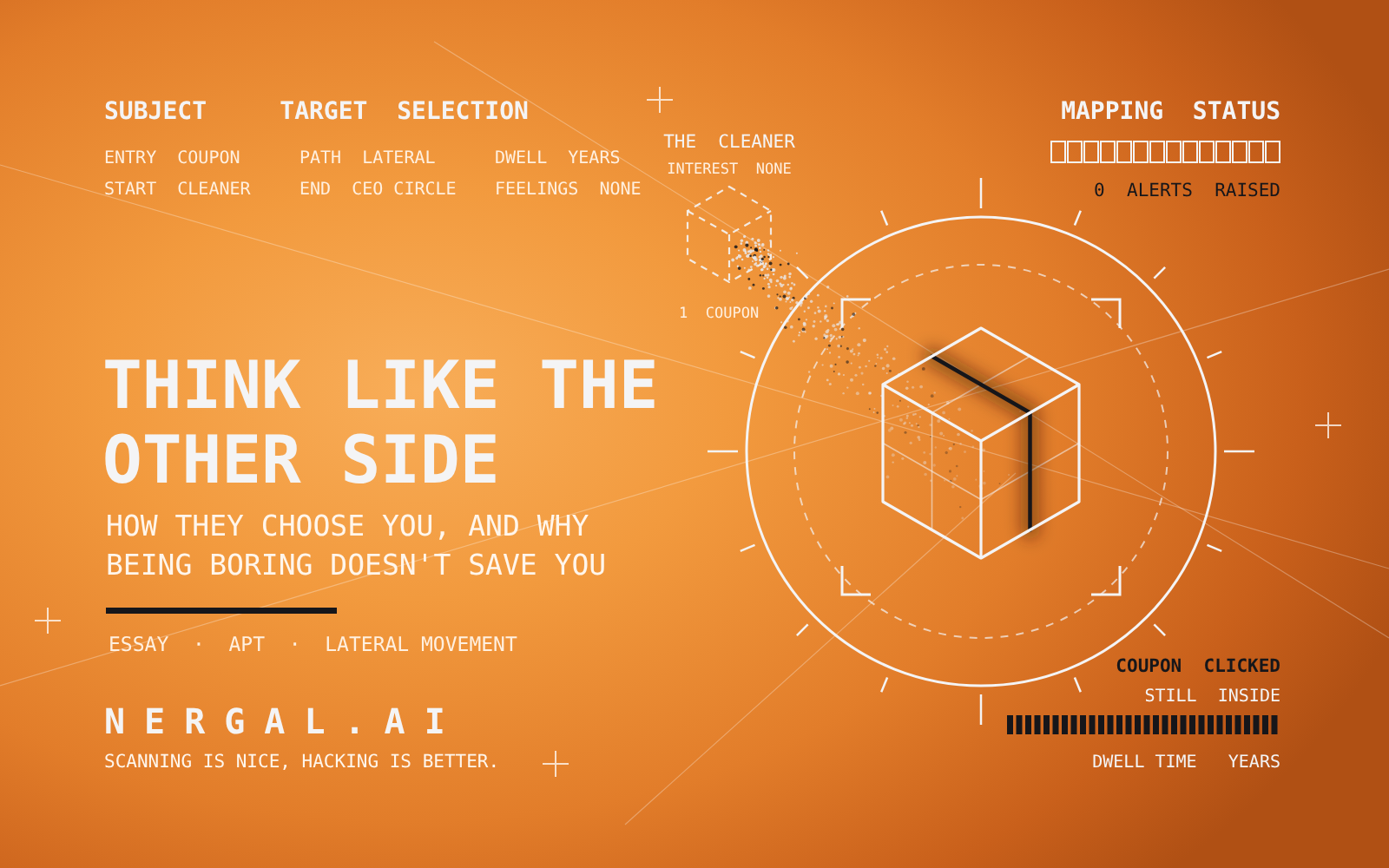
Why would anyone want us?
Ask a company why anyone would attack it, and you often get a shrug. Why would anyone want us? We're too small. Nothing interesting happens here.
That might be very true. Not your systems, not your information, not you as a person. But here's the part nobody likes to hear: being boring makes you more useful, not less. You're predictable. You're so normal that nobody would ever suspect you. And you probably email, quite often, with someone who is interesting to certain people.
Even if you really aren't interesting, that doesn't mean the one looking at you agrees. Nobody will bother turning on your camera to pressure you; what would be the point of pressuring someone who isn't interesting? You'll be used anyway: as a door, and as a base to come back to.
In the trade, moving from one person to the next is called lateral movement. Think of it this way. You want to know a secret about your partner. You can ask your partner, and they can lie. Or you ask their best friend, without saying it's a secret. Or you pick up their phone and read what they're texting. Same answer, and no lie in the way.
Still not convinced? Move on to their parents. Ask them, or take their phone. You never had to go through the front door.
Came for the gold
In the beginning, what they're after can be very narrow. But the more they learn, the wider it gets, and more targets become worth the time, the money and the brainpower.
What robber breaks into a jewellery store for the gold, finds the most prestigious watches in the shop, and leaves them because he came for the gold? Even if he has no idea what those watches are, he grabs them on his way out.
Money and information are the main targets, and they go hand in hand. Information turns into money, and where there's money, there's information. They used to have to read through thousands of stolen PDFs. Not any more: machines do the reading for them. So they can take as much as they like, as long as they stay invisible. And they know how to stay invisible.
Every file they take tells them what to take next. And as long as nobody sees them, they don't stop at two or three files.
It starts with the cleaner
Nobody wakes up one morning and says: let's target this person. They can spend months, even years, gathering information without touching anyone, mapping who is connected to whom.
And they don't start with the person most likely to notice that something is wrong. Every company has people who were never given anything serious to protect. Say the cleaner has a company email account, to see her schedule. It's easy to send her a coupon, something that will make her life easier: a better toolkit for work, or a vacuum cleaner for her own home. She clicks, and Pandora's box is open.
From her mailbox they learn how the whole company works. Maybe she logs in on a computer inside the building now and then; without mapping the company first, you wouldn't know. From there they find the people who deal with management, then management itself, then the CEO. And the CEO is in touch with the CEOs of other companies.
It started with a cleaner who thought her life was about to get a little easier. It ended with a whole circle of CEOs, connected to each other one way or another, and the other side holding a lot of information about an entire sector.
To pick the right person, you need to understand people. You have to see it from her side, not yours. She may enjoy her job and be happy with her life. She's also not the best-paid person in the building, and something free that helps her is welcome. She won't take the coupon apart to see what's inside.
And if she did sense something was wrong, which would be strange in itself, because spotting it is nobody's idea of a cleaner's job, then what? She doesn't have the money to take foreign agents behind an offshore front company, on an island nobody has heard of, to court. She couldn't hunt them down.
What you give away without knowing
Nobody monitors employees around the clock in their spare time, and on social media they give away more and more.
I've seen it myself. Employees of a company that sells security tools proudly posted a photo of their screen on LinkedIn, blurred. Not blurred enough. It showed what their tool could secretly read, something the company had never advertised, and a few real phone numbers someone forgot to cover. They knew they had posted it. They just didn't grasp what they had posted. Now I knew the hidden part of how their product works, and what to look for.
Then there are job ads. They tell you what the company is looking for: the specific software it runs inside, often outdated, and the kind of person it wants. Often there's a manager's email address to write to. Now you can skip the cleaner. And how often certain ads appear tells you how big the company is.
It's worse when it isn't a company but a government body. Follow its job ads long enough and you know what expertise it has in house, what it lacks, and what it's after. If you're clever, you can work out its budget.
A mosquito, not a kitten
They're not divers running out of air. Once they can get back into your system whenever they like, they can wait for years. Something with a deadline, they rush. But a company with a government contract they can follow for as long as it takes, staying inside and gathering what they want.
While they wait, there isn't much to do. Machines collect, store and analyse, and they work on many other cases at the same time.
That's the misconception: thinking they're personally invested in you. They aren't, and if you truly understand that, it makes them more dangerous, not less. You're not a stray kitten they'll take care of, or go easy on. At best, you're a mosquito. And when they don't need you any more, or the mosquito needs a smack, you'll feel the smack. Hard.
When Joe goes home
How good a defender is depends on where they work, and on how much they love what they do. At many companies people stay a year or two and move on. That mentality creates holes, and sometimes the feeling that if it all goes down the drain, so be it.
Say the defender does love the job. Then comes the next problem: how much money do they get for security, and how much say do they have over other people, to teach them what security is? Someone can be streetwise online, but if nobody listens, they might as well stay home.
Now look at the other side the way we looked at the cleaner. They often work for their country, their people, their cause, with the conviction of a believer. Reaching that level of expertise is an honour in itself, and they do the job proudly. Picture a young expert in his mid-twenties, in a country that rewards that talent with status. Doing better than his opponent makes his career, and makes his family proud.
His opponent is Joe Schmo. Joe dislikes his job, isn't paid well, isn't taken seriously, and can't wait to go home. The other side knows exactly when Joe goes home. That's when whatever entered Joe's system goes off. You'd have to be a very naive CEO to think Joe drives back to the office to stop it.
And even a Joe who loves his job wasn't prepared. All he could do was sit and wait for the day it arrived. The other side had years to study how things work, and knows Joe's system better than Joe does. Who tells the teacher how to teach? Under these circumstances, Joe can't stop it.
The water pump
The clearest example of how the other side chooses a way in is Stuxnet, the attack on Iran's uranium enrichment plant at Natanz.
Natanz wasn't on the internet, so there was no point trying to come in through it. So it came in the way everything the plant needed came in: from outside. Investigators found the first infections at companies that supplied Iran's nuclear programme (Engadget). According to a 2024 Dutch newspaper investigation, it came in on a water pump, installed by a foreign engineer with a business in the region, exactly the kind of man nobody thinks to suspect (SecurityWeek). It has never been officially confirmed.
And how would you know? A sealed pump you need is the last thing you'd open, let alone break, to see whether there's something inside that shouldn't be.
Is that easy? Given the circumstances, it was the easiest way there was. If you can't get in digitally, go physical. What you might call too sophisticated, too much effort, was a normal solution to them. Hypnotising an employee into connecting the plant to the internet: that would be strange, and far too much effort. Nobody did that. It just came in with something the plant needed. And guess what? It worked.
Nobody but you is watching
If you built the company yourself, you probably know this already: nobody is as invested in it as you are, and the few who come close are probably trying to replace you.
The people below you weren't hired to oversee the whole thing; that's what you're there for. They don't need to understand how everything works. You do. You have to see that things can go wrong, and that when they go wrong, they go really wrong. But don't expect anyone further down the pyramid to truly care about it, or even to believe it's real.
Sit in the other side's chair for an hour, and that's the first thing you'll see.
The sharp knife
Besides being very good with computers, they're very good with the human mind. They know things about it that most psychology books never recorded, because it's hard to write about, given the circumstances. They've already sat in your chair. They know how comfortable your bed is, and what's in your fridge.
Don't mistake them for hippies at a keyboard. They're not a charity. Their feelings aren't invested in you, because what they want isn't what you want. Whatever they find about you, they truly don't care: they've seen it all too often. But they know you do. They know a CEO who's doing well can't afford to be portrayed a certain way, or to have the world see what they thought was a secret.
They know that if you dig long enough, you can spin things that are true, and not that remarkable in the grand scheme, until they read as if the world is ending. They know how to pressure you so that you start moving in the direction they want. And they feel nothing while they do it.
Which also means they won't stop. Certainly not if you ask them to, even if you knew how to reach them, because they're most likely following orders of their own. You'll just see your data stolen, or things going really wrong that you can't explain.
Think of a surgeon. A surgeon doesn't cry during an operation. They see blood, they see open bodies, and depending on the surgery, they can hear the family crying. That's not why they became a surgeon. Nor do they feel bad that the knife is really sharp. The sharp knife is the whole point.
So what does work? The secret is that the weapon is the same: what they use against you is what you should use yourself. It costs money, of course, but everything really good has a price tag, and in security, taking it seriously is the foundation you build on. Let someone hack you, really hard, the way they would. Then you see every way in to the juicy information, including the ones nobody knew were there. Each one you close is an opening they no longer have.
The clever reader will see it: from where the other side stands, with what it's after, all of this follows. The one who thinks it will never happen to them, that we're all just people and only love exists, can ignore it. They'll find out that when I say things can go wrong, I mean really wrong. By then, it's too late.
Sources
- Dutch engineer used water pump to get billion-dollar Stuxnet malware into Iranian nuclear facility: report, SecurityWeek, January 2024, on the de Volkskrant investigation
- Stuxnet worm entered Iran's nuclear facilities through hacked suppliers, Engadget, November 2014
- US, Israel used Dutch spy to launch Stuxnet malware against Iran, Dark Reading, January 2024