NERGAL on the Optimizely Hack: Zoom, BBC, CNN and 175 Others Served Malware. $7,040 Is Only the Start
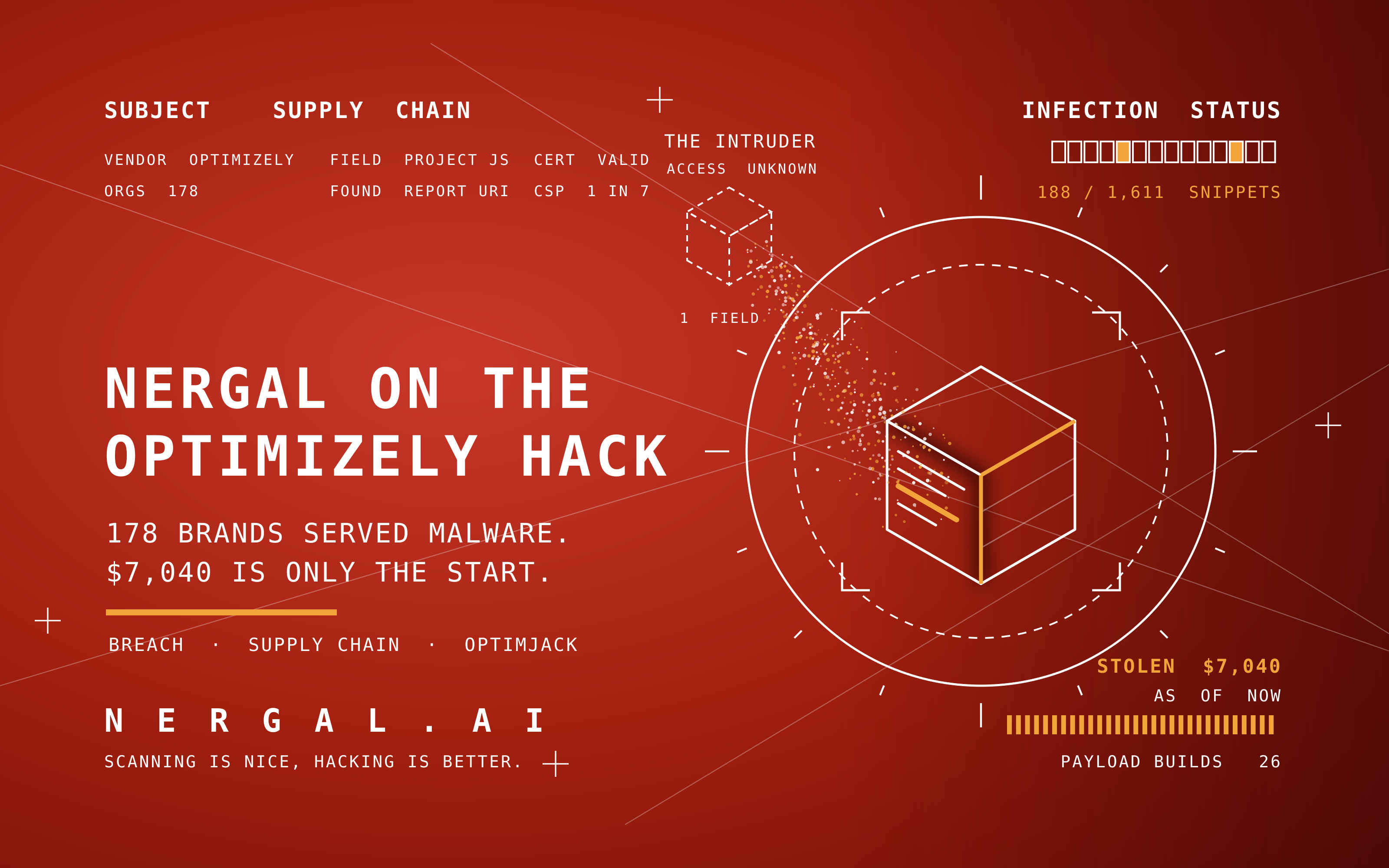
OPTIMJACK, the supply-chain attack on Optimizely, put a crypto stealer, a card skimmer and iPhone exploits on 178 of the world's biggest websites. Here is what happened, and why we don't believe it was a one-day job.
Key facts
| Fact | Detail |
|---|---|
| When | Monday 16 November 2026, first seen 04:21 UTC, mostly cleaned up by 21:10 UTC |
| What | Attacker code written into the Project JavaScript of Optimizely Web customers and served from cdn.optimizely.com |
| Who was hit | 178 organisations (188 snippets), including Zoom, BBC, CNN, HSBC, Salesforce, GitLab, IKEA, Equifax, Air France-KLM, Ledger and Peacock |
| What it did | Swapped crypto addresses, skimmed cards, stole cookies and screenshots, served iPhone exploit kits |
| Stolen so far | About $7,040 in crypto, as of 19:25 UTC on 16 November |
| Found by | Scott Helme, Report URI |
| How they got in | Unknown. Optimizely has not published a statement |
On 16 November 2026, some of the biggest websites in the world spent a day serving malware to their own visitors. Zoom, the BBC, CNN, HSBC, Salesforce, GitLab, IKEA, Equifax, Air France-KLM, Ledger and Peacock were among 178 organisations whose pages ran an attacker's code for hours, and none of them had been hacked directly. The code came in through Optimizely, the experimentation platform they had all invited onto their sites to run A/B tests.
The attack was found and documented by Scott Helme and his team at Report URI, who swept 1,611 Optimizely snippets and found 188 of them infected; online it has already picked up the nickname OPTIMJACK. The findings below are Report URI's, and the reading of what they mean is ours.
What happened
Optimizely Web works by having each customer load a small JavaScript file, a snippet, from Optimizely's servers. Besides Optimizely's own code and the customer's experiments, that snippet carries a field called Project JavaScript: custom code the customer writes in the Optimizely dashboard, which then runs on every page of their site.
The attacker wrote their own code into that field across customer projects and left the rest of each snippet untouched. The malware was therefore delivered from cdn.optimizely.com, with a valid certificate, by a supplier every one of those sites had deliberately chosen to trust. Customers who served the snippet from their own domain received it as well, because the content came from the same project, and even Optimizely's own sites, its login page included, were serving it.
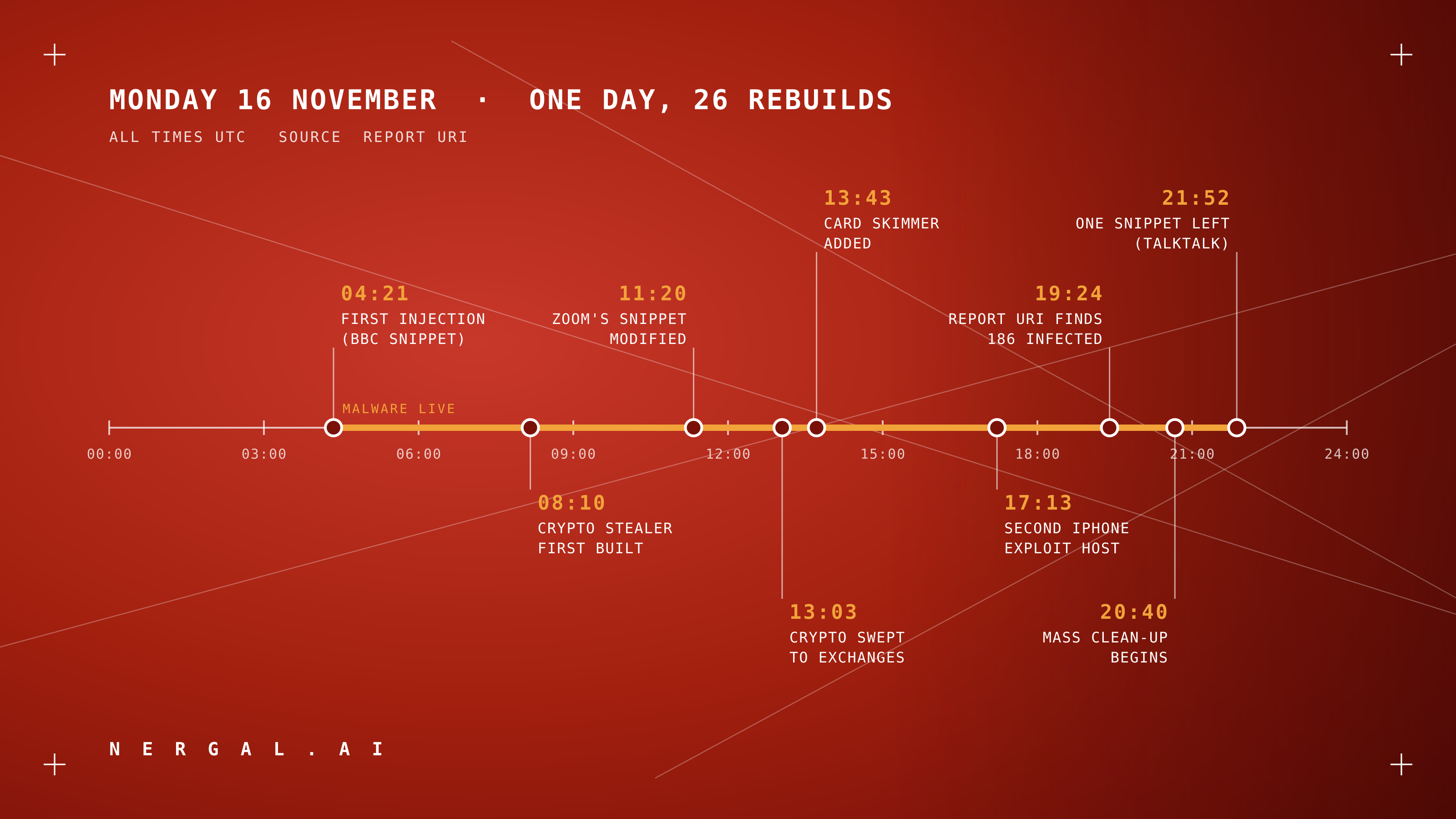
Report URI first saw the injection at 04:21 UTC, in the BBC's snippet. Over the course of the day the attacker rebuilt the payload 26 times, added a card skimmer in the early afternoon and iPhone exploits in the evening, and most of it was only cleaned up between roughly 20:40 and 21:10 UTC; at 21:52 a single infected snippet, TalkTalk's, was still live. It was not the actor's first run, either: Report URI traced an earlier wave through Kissmetrics, StorifyMe and Minute Media scripts between 13 and 16 November, and the same injector back to Turkish websites in September.
What the code did
The payload was built to make money from whoever happened to drop by. Its main trick was swapping cryptocurrency addresses: whenever a wallet address appeared on the page, in a form, in an outgoing request or on the clipboard, the code quietly replaced it with one of the attacker's, across Bitcoin, Ethereum, TRON, Solana and four other coins.
From 13:43 UTC it also skimmed card numbers, expiry dates and CVVs from form submissions, although cards typed into hosted payment frames were out of its reach. Whenever it swapped an address close to payment or wallet wording, it sent home the page address, any cookies a script could read and a screenshot of the page.
On iPhones and iPads it went considerably further, loading one of two exploit kits through a hidden frame: Coruna for iOS 13 to 17, DarkSword for iOS 18. Devices running iOS 18.7.3 or later, or 26.3 or later, are patched.
By 19:25 UTC about $7,040 had reached the attacker's wallets, most of it in a single Bitcoin wallet, and the stolen funds had already been swept out to exchanges early in the afternoon.
Second time around
This is not Optimizely's first incident this year. In February the company confirmed that an attacker had got into its systems through a voice-phishing call, and said the intruder had been unable to escalate privileges, install software or plant backdoors, and had taken nothing beyond basic business contact details. Nobody has shown that February and November are connected, and Optimizely has not said how this one happened.
But if someone had got into my systems earlier in the year, I would have become paranoid, so paranoid that my own employees would call me crazy. You might have said that was overdoing it; after Monday, nobody would say that.
Even if the people from February have nothing to do with the people from this week, February was the warning, and nine months later someone still found a way to write code into the websites of 178 customers. My own bet is that it is the same crowd, and further down I will explain why.
The butcher and the cow
I cannot be angry at a CEO for not being paranoid enough to be called crazy. The problem sits somewhere else: a company like this chooses to do business in a field its leadership does not truly understand, which is technology, computing and, in the end, hacking. Being a CEO is not hacking, of course, but the company promises its customers a service they can trust, and its policies list everything it does to keep their data safe. That all reads very nicely, yet if the people behind the policy do not understand what it is for, or what it is up against, the policy is worthless.
Most of what lives in the digital world today was built by people who do not own the company. The CEO hires people to build it for him, and after a while parts of it go out of date, or turn out never to have been built to the quality anyone would expect. The average CEO does not understand that this calls for continuous security checks, rather than one test a year and a certificate on the wall.
A butcher used to eat his own meat. He knew what kind of cow it was and where it came from, and quite likely he had raised it himself, or his neighbour had. The modern CEO sells a digital product without ever tasting it: he understands the commercial side, and that is very often where his understanding stops.
Clients will walk
I can tell you from experience that this will come back hard. A smaller competitor that never made the news will pick up the clients, because a supplier that has shown it cannot keep its own house in order has very little left to sell, and any sensible client ends that relationship.
People like to say that everything can be hacked, and maybe it can. But you do not hear every week that the CIA has been hacked, and when its worst breach did come, with Vault 7, it took one of its own engineers on the inside. That is because the agency understands the world it operates in. Does every CEO need to run his company like the CIA? No. But then he should not expect his clients to stay when things go down the drain. It is a hard hit to take, but it is reality.
A key without a plant pot
Whoever pulled this off did not do it in a day. Writing code into the projects of 178 unrelated customers takes a deep understanding of how the platform works, and to me that points to someone who had a foothold for a long time. A first break-in, even a small one, buys an attacker time: time to map how the systems work, to learn the routines and to watch how the company reacts once it notices. My read is that the first break-in was the moment they stayed inside, and that they waited until they knew the ins and outs of the system better than the people running it. The first visit is reconnaissance; the second one is the job. To be fair, Optimizely said in February that the intruder could not plant anything, and Report URI's own guesses range from a compromised internal system to a single credential with access across customers. We will know more when Optimizely explains.
If nobody truly understands yet how it happened, here is where I would start. I won't solve it for free, but I will point. Only 188 of the 1,611 snippets Report URI checked were touched, so the attacker did not hold the keys to every project, only to a particular set of them, and whatever that set has in common is the way in. Keep the search broad, and do not ignore any of the usual suspects: an internal support or admin account that can edit customer projects, an outside agency or integration that runs tests for many brands at once, or an API token with more reach than anyone understands at this moment.
Every affected customer can help answer the question today. Open your project's change history and look at who, or what, edited Project JavaScript on 16 November. That name, or that token, is the lead, and I can promise you that cases get solved with far fewer leads than this.
Now that it has all hit the fan, the company is scrambling, while the attackers feel nothing beyond the satisfaction of a job done. They simply move on to the next step, which here is almost certainly cashing out the crypto and laundering it.
There is a lesson in the product itself, too. Every bit of hocus pocus you add to a system is one more thing to understand and protect: more to patch, more to monitor, and more specialists for each moving part. A box where customers can write code that runs on every page of their site sounds wonderful in a sales meeting, but none of those customers wanted their visitors served a crypto stealer from it, and I would not be surprised if people started calling the company Drainly.
In an earlier essay we wrote about the key under the plant pot. Being hacked once and never fully understanding what happened, or where the attacker went, is worse than that: it is a key lying in front of the door with no plant pot at all. If I could not establish exactly what had happened, and it truly was a hack, I would have replaced the whole system. That costs money, and no CEO likes spending it, because once again he is not the butcher from the old days. A butcher who knew his cow was sick would never have kept selling the meat.
Pickpocket or art thief?
In our piece on ARTEX we wrote about pickpockets with a robot army: amateurs who fire at everything and cash out almost nothing. On paper this looks like one of them, with a clipboard swapper and about $7,040 in the wallets. I would not celebrate yet.
If someone really sat inside a supplier's systems for months, that alone says a great deal about the skill involved, and calling this a $7,000 job would be very stupid. That is only the figure as of now. The iPhone exploit kits are the part that worries me: every visitor on an older iOS who opened one of these sites that day was handed one, and it would not be a stretch to think the attackers now have a foothold on far more devices than anyone has counted.
And even if it really did stop at $7,040, the attackers walked away with something worth far more: a lesson. Right now they can sit back and watch, in real time, how Optimizely and 178 of the world's biggest brands respond to being hit, and from where they are sitting it looks like nobody knows what hit them. That is very, very nice learning material for whoever did this, and you can be sure that lesson will not be lost.
And since nobody yet knows what those 178 customers had in common, I would not even start adding up the damage. First you have to understand the basics, meaning how they got in, what they touched and where they still are; only then can you move on to the specifics.
Why only one in seven was safe
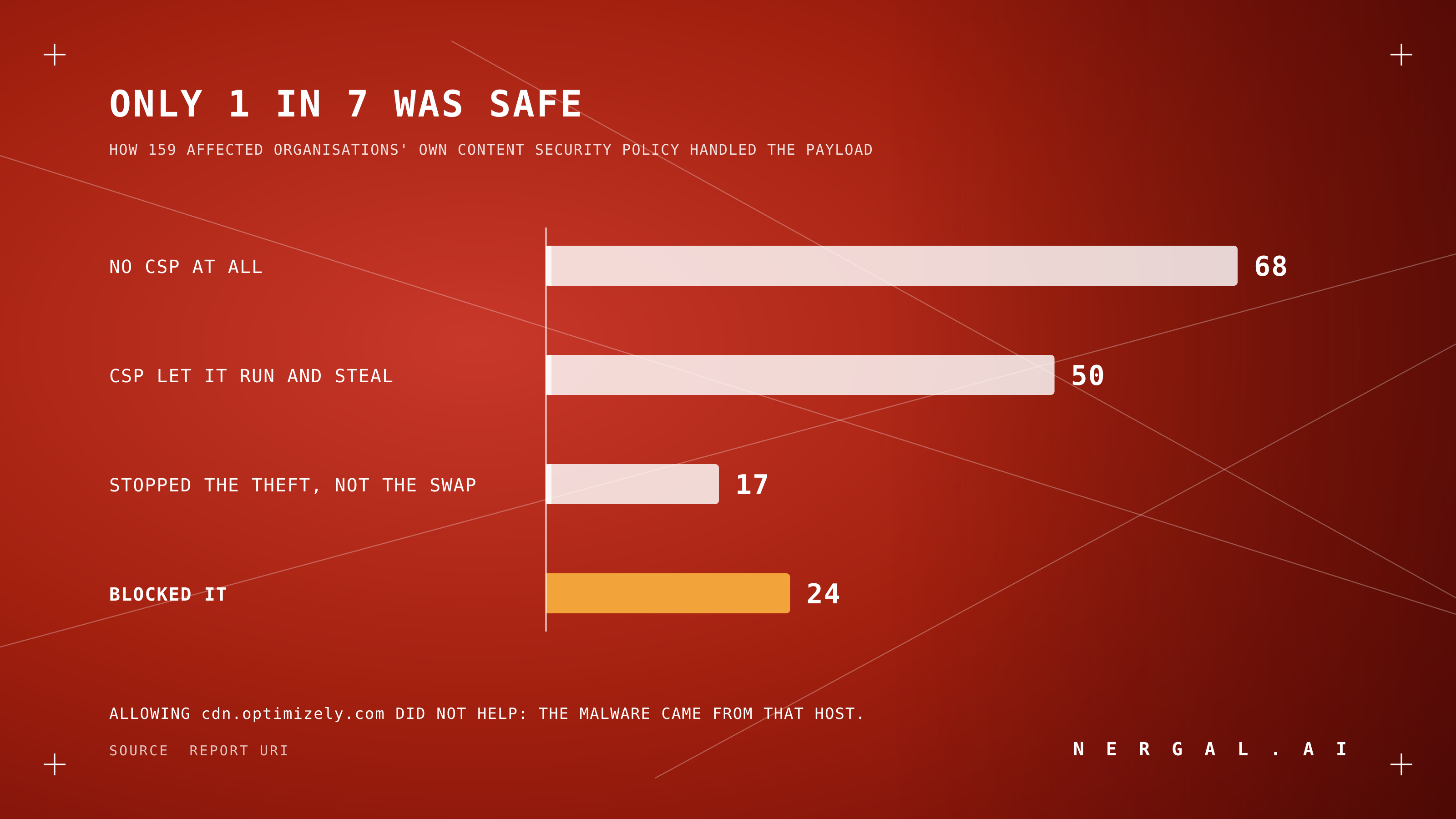
Report URI also checked whether the affected companies' own websites would have stopped the payload. Of the organisations it could evaluate, 68 had no Content Security Policy at all, 50 had one that let the malware run and send its data home, and 17 blocked the data theft while the address swapping carried on. Only 24, about 15%, blocked the payload outright. Listing cdn.optimizely.com as trusted did nothing, because that is exactly where the malware came from; what made the difference was how tightly a site controlled which scripts could run at all.
Why so few? It comes back to what we wrote in Think like the other side: you have to understand how the attacker sees you. If you think a simple update, or a policy sitting somewhere that only applies under certain circumstances, is going to save you, then I have another surprise for you, because that is not the only thing you have to do. These settings stay broken for one reason: the companies running them never tried to hack themselves first.
The butcher and the surgeon
Would a penetration test have caught this before Monday? An average one, absolutely not. A good one, maybe. A professional one, built by people who understand how the other side thinks? Absolutely yes. For Optimizely that means the way in; for its customers, the simple fact that one supplier could run any code it liked on every page of their sites, with nothing in place to stop it.
Saying that out loud is pointless, because it makes you sound cocky. But if you want my unfiltered opinion: who would ask the butcher to perform their surgery? Both work with a knife, with very different results. So let us be the surgeon who tells you exactly what is wrong and what you need to do about it. And once again, no, not everyone would have found this.
Check yourself in five minutes
If your site loads an Optimizely snippet, do this today. A clean snippet now does not prove it was clean on 16 November, because most of the clean-up happened that evening.
- Fetch your snippet from cdn.optimizely.com, and from your own domain if you serve it yourself, then open your Project JavaScript and every experiment's custom code.
- Search for
1688360,atob(,window._k7,window.__k7b,data-channel-code="02111110"andBIGNIAO, and for any script you did not write. - Open the project's change history and note who, or what, last edited Project JavaScript, and when.
- Search your logs and CSP reports for connections to
1688360.cc,webshell.lol,linkforge.cc,ios-hack.icuand the other.icudomains in Report URI's list. - Rotate every Optimizely user password, API token and integration, plus any session tokens or secrets stored in cookies that scripts can read.
- If your own forms take card details, treat cards entered on 16 November as exposed and talk to your payment provider.
- Put a strict Content Security Policy in place: a tight script-src and connect-src, no 'unsafe-eval', and reporting switched on.
What to do now
For visitors, the practical steps are simple. Update your iPhone or iPad to iOS 18.7.3 or later, or 26.3 or later. Check the address every time you send crypto, character by character, rather than trusting whatever you pasted, and if you entered a card on one of the affected sites on 16 November, keep a close eye on your statements.
For the affected companies, the checklist above is the bare minimum.
My own advice goes further, and for ninety percent of them it will disappear into the void. It is the same advice I would give the CEO: be paranoid, and find out exactly where and what happened. If you cannot, replace everything. Unless, of course, you do not truly care about your company, or you cannot see the magnitude of what just happened to you, in which case you are also the person who does not understand that your customers will not like it when the same thing happens to them. Or you have no customers at all, and then by all means ignore every word of this.
Everyone else: taste your own meat. Hack yourself first.
Sources
- World's Largest Brands Infected With Malware Via Optimizely, Scott Helme, Report URI, 16 November 2026
- Optimizely confirms data breach after voice phishing attack, Paubox, February 2026
- The sweaty lone nerd is dead, Nergal
- Think like the other side, Nergal
- CNN, Zoom, Fox News Served Visitors a Crypto-Stealing Skimmer – OPTIMJACK, Amirul Cyber, 16 November 2026
- OPTIMJACK: Optimizely-Hosted Scripts Loaded a Crypto Clipper and Card Skimmer on 186 Confirmed Sites, StepSecurity