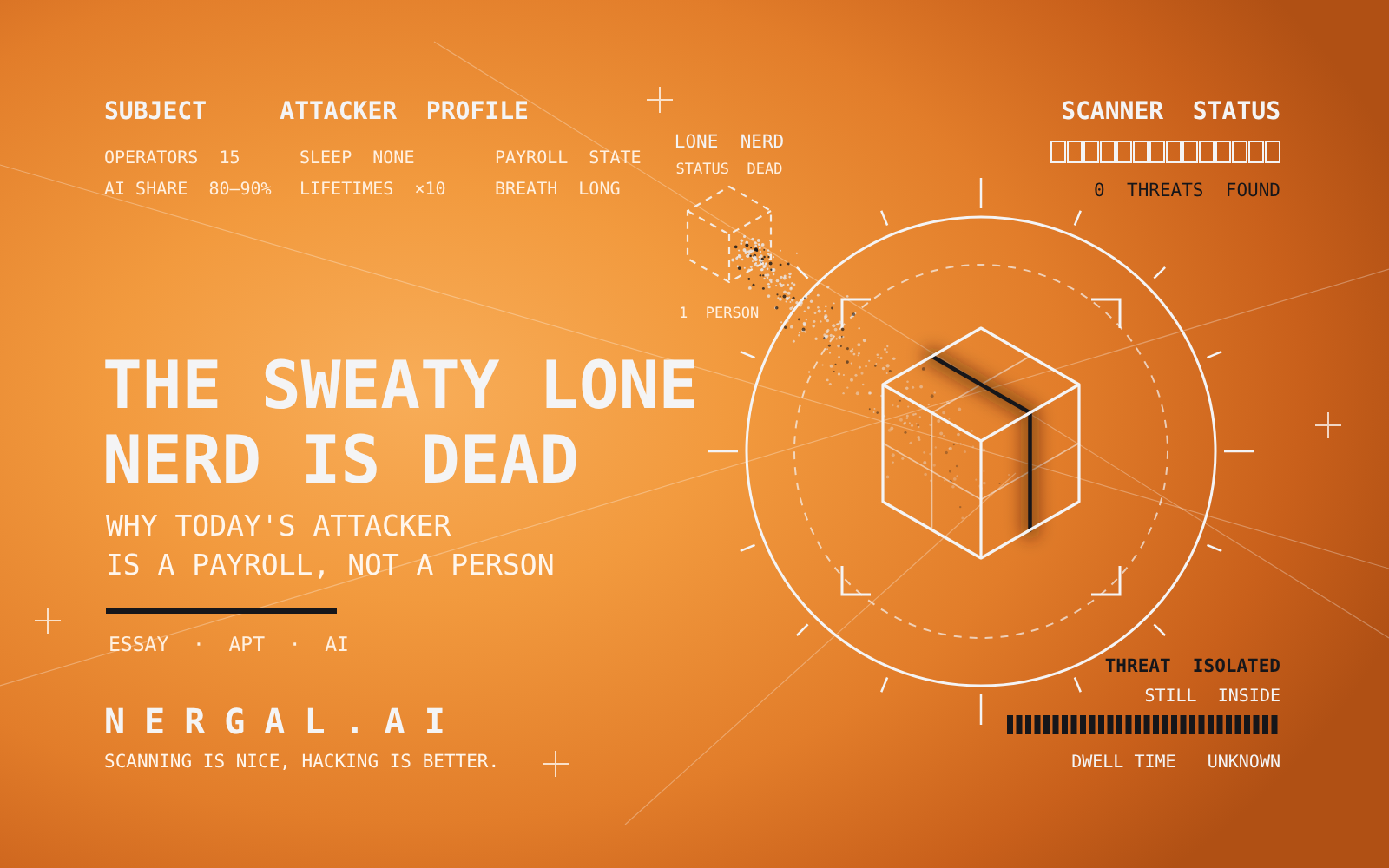
The sweaty lone nerd is dead
Why today’s attacker is a payroll, not a person.
The picture everyone has
Ask people to picture a hacker and you get the same answer almost every time. A lonely guy in a dark room, a black screen, green letters, nothing better to do with his life. Slightly sad, slightly funny, mostly harmless.
That picture says more about what people don't understand than about hacking. Hacking isn't a screen. It's making a system do something it was never meant to do.
If you know which buttons to press on a soda machine so the price on the display changes, and the machine really charges you less, or nothing at all, you've hacked it. You can already see the motive, too: a free drink.
Most people who meet a real hacker never find out. They never connected their slow computer to anyone. They don't know their personal details are already out there, in the wild. They never see who did it, and that is not an accident.
The first hackers built the world we live in
The sweaty nerd was never the true picture. From the very beginning of computing there were people who understood it at a far deeper level. They had no guides, no manuals, no references. They invented the system itself.
I don't mean the friendly screens you tap on today. I mean the core of the core: the most boring material on an old monitor, and the imagination to see, in very abstract terms, what could grow out of it. Those people were hackers in the truest sense. They were so good that they hacked our reality: our jobs, how we meet each other, how we talk.
Why does that matter? Because to understand how something works, you also have to understand how it breaks. You cannot build anything fundamentally strong without knowing its weaknesses. Know the weaknesses and choose to do harm with them, and people will call you a hacker.
The lone attacker, and the ones nobody saw
Then computers spread. People started emailing, reading the news online, typing searches into Google. Most of them only consumed, but a few wanted to know what was underneath, and understanding it better than everyone else is exactly what made it breakable.
Not long ago, before AI reached its current level, the worst attacker you could meet really was alone in his room. Far from stupid; often the opposite. Misunderstood, with sharp skills and badly aligned feelings, he found in hacking a form of revenge, a way to feel safe without being seen, or a shortcut to fast money without leaving the house.
Some of those operations grew into businesses. Ransomware stopped being one person's weapon and became a product, rented out to affiliates for a cut of every ransom. LockBit, one of the biggest, has been linked to Russia, and US victims alone paid it more than $90 million across roughly 1,700 attacks since 2020 (The Register, on the CISA joint advisory).
And next to them, the whole time, were the teams nobody saw: advanced persistent threats, working for nations or hired by them to spy on other nations and their companies. Highly trained minds, very good abstract thinkers. In my experience they share the taste for isolation, and here it comes with the job: they can't brag. For people working for a state, secrecy is part of the work, often by law; for criminals, talking is how you get caught.
While everyone else goes to festivals, their wildest night out is a conference hall full of other sweaty men, swapping stories they're not allowed to tell.
Most people never realise these teams exist, and that is part of their toolkit. The only ones who see them are other nations doing the same thing to each other. That's part of the deal of being a nation online.
Ten lifetimes, and a payroll
Some of what I worked on would make headlines. How, when or where? Even if I gave you an answer, you can bet on it that it wouldn't be true.
Then comes the moment you can no longer ignore who you're up against. Even if I hadn't slept for weeks, I couldn't have done what certain teams were said to have done in the same time. The range of skill alone would take ten lifetimes of very gifted people.
That isn't one person. That's a payroll. A state pays them to deliver, and as long as the results stay interesting, the money doesn't run out.
You're not up against a sweaty nerd any more. You're up against an organisation, with a very long breath, and that changes how you have to defend.
Three kinds of CEO
If I had one minute to describe today's attackers to a CEO, it would depend on which of three CEOs was sitting across from me.
The one who has never dealt with it. For them it all sounds a bit exaggerated. But the strongest motive out there is money, and where there's money there's knowledge. Information is the centre of a modern economy, and that makes almost every company interesting.
The one who was hacked and doesn't know it. They were good enough to get away with it, and you may never find out how. Then one day a competitor on the other side of the world has exactly your recipe, out of nowhere. Your next big idea, too, at the same moment. Well, I have a surprise for you: you've been hacked. Maybe you still are. Maybe some of the people doing it work inside your company.
The one who knows. They're high enough up to be advised, and they understand how far this goes. Remember the soda machine: I never said it had to be a computer. People get hacked too, and a hacked person makes hacking the systems around them much easier.
So this CEO knows that not every charming stranger is there by chance, and not every new friend is a friend. The other side has a very long breath to get close. They don't use an ordinary phone. They don't charge it in just any socket, don't have deliveries sent to their home, stay out of places where they know they're on camera, and switch cars two or three times on the way to the office.
Most people around them never see any of it. They usually didn't start out like this; they learned it as they rose. At a certain level, it is a jungle, and it translates straight into what you see in your bank account.
Some people shrug: let them take my information, I don't care about money anyway. You don't want to find out how dark the jungle gets at night. They can download things in your name, the kind of things you warn your children about. The camera you look past every day can record you at home late at night, reading your screen, in whatever you happened to be wearing. All of it can be used against you.
Then the pressure comes, through every channel they can find, with your own pictures and recordings attached. The average person isn't made to endure that. And here's the funny part about the money you didn't care about: now it's the only way out. Nobody can help you unless, at that moment, you still have enough left to hire the right minds, people bright enough to advise you and try to undo the damage. Pay enough, with no guarantees, and maybe they slow down. Or maybe they make it worse.
And if it ever happens to you, you'll find out this was the gentle version.
Whichever CEO you are, remember this: you won't find out from an alarm. You'll find out from what the other side suddenly knows.
Now add AI
What took me a long time back then would be a side task for a good AI model today. And in hacking, a side task can still change everything. Most people won't understand that until it hits them.
Remember the person who knew it all, worked impossibly fast and never had to sleep? That person now exists. Take fifteen people from an advanced persistent threat, with their computer knowledge and their tradecraft, and let them speed up everything they do with AI.
This is no longer a thought experiment. In September 2025, Anthropic caught a group it assessed as Chinese state-sponsored using its AI model against about 30 organisations: tech companies, banks, chemical manufacturers and government agencies. The AI carried out an estimated 80 to 90 percent of the hands-on work, at what the report called "physically impossible request rates" (Anthropic).
And remember: hacking isn't only about computers, it's about the human mind. What happens when they ask an AI to sum up your psychology, or to write the perfect email from everything they already took from you?
Suddenly it isn't hard to make new friends, because your new friend is exactly what you were looking for. The stranger at the bar who shares every one of your hobbies. The friend from the gym with exactly your past, so close it's almost strange you didn't grow up next door. Now I have another surprise for you: all of it came from your own online history.
They don't even pay for the AI. Security researchers have a name for attackers running AI on stolen accounts, LLMjacking, with the victim footing a bill that can pass $46,000 a day (Sysdig). And the state money is still behind them.
A fast, sharp, patient team, accelerated by a mind that never sleeps. Now it becomes interesting. Now you have a real problem if they pick you.
The scan illusion
Most companies still defend against the old picture. Ask why a computer is slow and people say "a virus", with faint memories of pop-up ads they never want to see again. That's why they bought a scanner.
A few years back, many slow, noisy computers were secretly mining cryptocurrency for someone else. Symantec blocked more than 8 million cryptojacking events in December 2017 alone, mostly mining Monero on ordinary machines (Symantec). Anyone able to do that knows how to slip past your scanner, and that is nowhere near the level of a state team. They could explain it to you just waking up after a DEFCON weekend.
Here is the part most people never think about. A classic scanner recognises what it has already seen. Every time it says "this is bad", someone was infected with it first, maybe for a year, before it landed in the database. What if you are the first?
Modern scanners also watch for suspicious behaviour, which helps. But a serious team tests its tools against those scanners long before they ever touch you. They don't use attacks aimed at everyone. They pick you out, and they adjust it to you.
Meanwhile, a friendly message in the corner of your screen says you're still protected, and there's a Christmas discount on an even bigger scan. It feels like safety. Every advanced persistent threat knows exactly what it is.
It gets worse. Sometimes the alarm going off, and the way you react to it, is part of the trick. You remove half the problem, you feel relieved, and that was the move that let the whole Trojan horse in.
Maybe one day someone in your own security team asks who exactly is uploading terabytes of data, and an investigation starts. By then a good team has dissolved, erased every trace, and it looks like it never happened. Until that competitor on the other side of the world has your next idea too.
The key under the plant pot
I can show you that your front door is closed, and deliberately not tell you that the key is under the plant pot. Pointing at a closed door is enough of a test to show you it's closed. It proves nothing.
The moment I can tell you where the plant pot is, and what's beneath it, everything changes. That's the difference between a test that ticks boxes and one that actually tries to get in.
A scanner can't tell you whether a system is weak, only whether it matches something already known to be bad. That's nice. It isn't enough.
So the only thing worth acting on is what can be proven. Not a long list of maybes, and not a document you hand to customer support. Proof that the skilled person on your own payroll, the one paid to keep you safe, can read and reproduce: here is the key, under the plant pot, by the front door.
And the companies that never get hit? They're either unaware that they were, or they have nothing worth taking.
Paranoid is a job description
In the end, it's always people. Bad code, someone using AI with bad intent, or plain naivety: every hack narrows down to people, one way or another.
And you can't hire your way out of it. People who are paranoid around the clock and charming at the same time, trusting no one while everyone trusts them, have another name: spies. Companies hire people for the job they need done, and that's how the world works.
The person behind the screen sees a message in the corner: threat isolated. Isolated sounds like solved. It isn't, and nobody in the company, not even the security team, can tell them what actually happened. So it gets ignored, because as long as nothing screams, it must be fine. Personally, I would scream at the idea of logging my own accounts into a smart TV in an Airbnb. Most people would call that paranoid.
At the very top, it's the other way round. People send their king or queen wine, chocolate, a cuddly toy, and none of it will ever come anywhere near them, physically or otherwise. However kind the sender is, and that's nice, a lead security adviser writes the name down and checks it first.
Any other name that comes up is checked too. And if there's camera footage of whoever handed it in, the name on the parcel is held up against the person on the camera. There they don't call that paranoia. They call it doing the job.
From where you stand, it was only a box of chocolates. To whoever receives it on behalf of the king or queen, the fact that you tried is a very big issue. That security adviser is no virus scanner that says "nice, it's isolated now" and moves on. The only thing that gets isolated is your wine or chocolate: X-ray scanned, then locked in a storage facility far away from the king or queen, before it's ever opened. The adviser is paranoid by profession, and investigates what happened and why: why you tried, and what you were after. And if it turns out to be plain naivety? Then so be it. But if anything bad ever happens to the king or queen, your name will be at the top of the list.
You can't hack a king or a queen: they are gated, protected, and no stranger gets close. That distance isn't arrogance; it's how they have kept the title for hundreds of years. If naivety were what it took to wear a crown, the world would be full of kings and queens.
History is full of courts torn apart by someone let too close. Even at the height of Ottoman power, Suleiman the Magnificent saw his own heir executed in 1553, a tragedy long blamed on intrigue inside his own household.
Digital Krav Maga
Nothing will stop them. Unless you learn to fight the way they do. Call it digital Krav Maga: you don't wait for the first punch. You train against the real thing, with their own weapons, under real pressure, until their weapon becomes your protection.
You don't have to become the fighter yourself. The leaders who understand this best are rarely the strongest in the room. They're the ones who see the board from above, and they know exactly what they can and can't do themselves.
So they don't learn Krav Maga. They find the best fighter they can, and they say: you take this one for me.
The most expensive investment you can make, with the least return, is not spending on security. Take it seriously, because if you don't, someone else will, and not to your benefit.
The sweaty lone nerd is dead. The ones who replaced him never sleep, and never stop.
Scanning is nice. Hacking is better.
Sources
- Disrupting the first reported AI-orchestrated cyber espionage campaign, Anthropic, November 2025
- LLMjacking: stolen cloud credentials used in new AI attack, Sysdig, May 2024
- LockBit joint advisory, The Register on the CISA-led advisory, June 2023
- Cryptojacking: a modern cash cow, Symantec Internet Security Threat Report, 2018