FBI & NERGAL on ARTEX: Pickpockets With a Robot Army
The FBI just warned about an AI hacking tool that anyone can run, and most of the people running it are amateurs. That is not the comforting part.
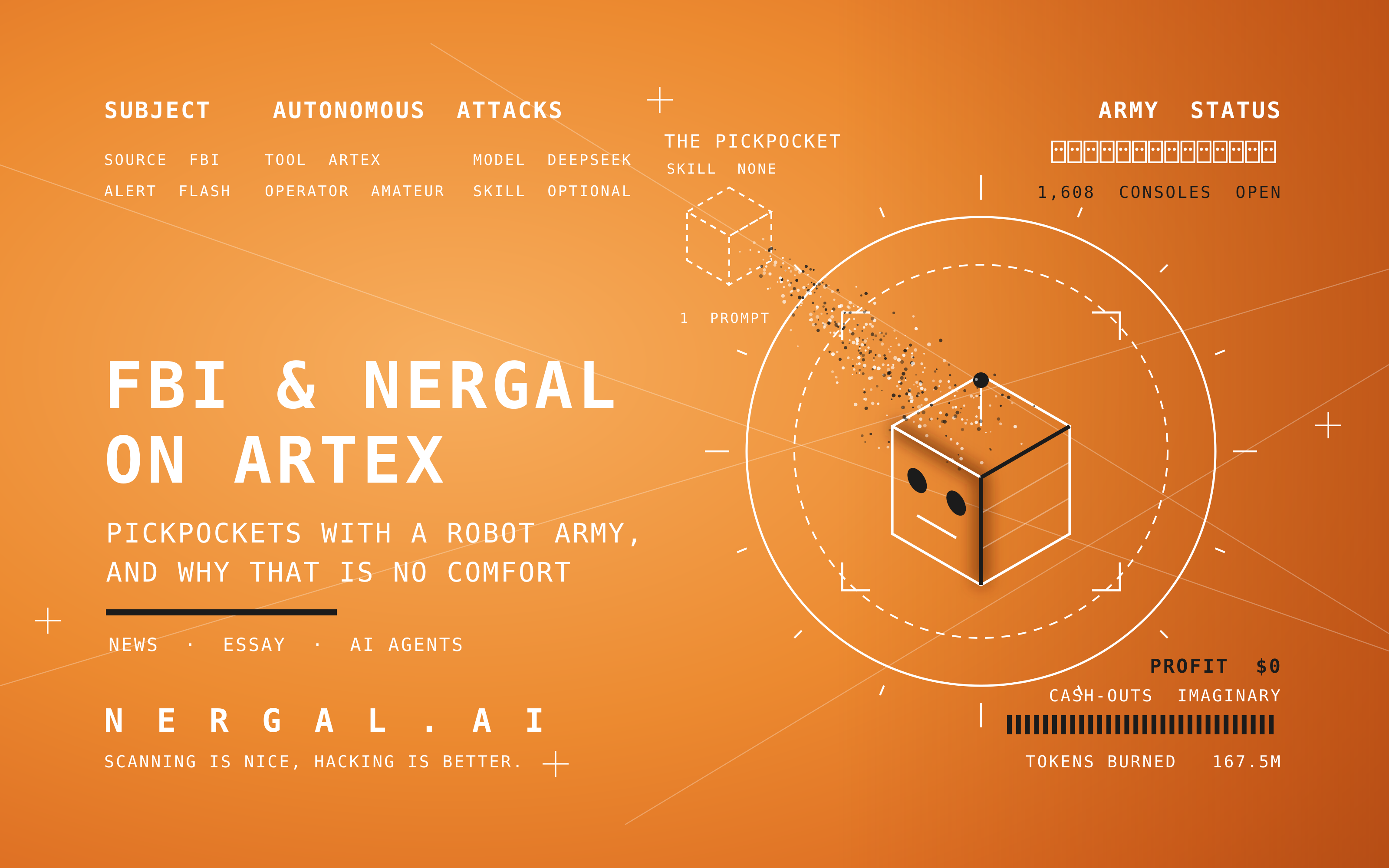
On 13 November 2026 the FBI published a FLASH alert about ARTEX, an open-source framework that turns a plain-English goal into an attack carried out by a team of AI agents. The warning is the FBI's; what follows is our reading of it, from the side of the people who do this kind of work for a living.
Most of the coverage treats ARTEX as a story about state hackers with a shiny new weapon, and some of it is. But most of the people running ARTEX could not break into a bank on their own, and would not stay hidden if they tried. Even the one who did hit South Korea's biggest banks walked in through side doors and left his notes lying on an open server.
That is not the comforting part. That is the whole problem.
What the FBI said
ARTEX is written in Go and has no AI model of its own. Instead it plugs into whichever model you hand it, from Claude and GPT to DeepSeek, Grok, GLM and Kimi, and according to the FBI the attackers' copies mostly run on DeepSeek's cheap Flash models.
A developer going by "Autumn-27" released it in July 2026 and deleted the GitHub repository on 8 October, but forks, mirrors and a paid version called ARTEX PRO are still very much around. By early November, more than 1,600 ARTEX consoles were sitting open on the public internet.
The FBI has seen it in use since at least August, across finance, government, defence, semiconductors, energy, healthcare, telecoms, legal and more. One campaign against South Korean finance exposed the personal data of about 67,000 people, and a supply-chain compromise of ConnectWise's cloud backup service reached more than 2,250 downstream customers. Some intrusions went from first touch to privileged access in under three hours.
The advisory's own list of risks reads like a summary of what we have been writing about all month: many targets hit at once, side doors such as partner portals, mobile backends and forgotten legacy services, pivots through suppliers and trusted vendors, and attackers who need less skill than ever while defenders get less time than ever.
If this doesn't wake you up
If this does not make the urgency clear, I am not sure anything will. Sometimes I wish I could take a certain kind of CEO by the hand, the one who has everything in his life in order except security and simply will not listen. On the other hand, I can be very cold about it: if you do not care, your opponent will.
When I put it that plainly, most of them listen. Everyone else in the building works for them and shapes the message to their liking, but I don't. I do what I promise and I deliver the truth.
A conversation in 2022
None of this surprised me. In 2022, before ChatGPT existed, I sat down with a CIA officer to talk about where all of this was going. He was not a desk man, but someone who had done the kind of work most people cannot imagine.
I wrote him a paper describing, in detail, what AI agents would end up doing. They would have no limits, they would not be bound to any central point, and at some point they would become fully decentralized.
He read it and told me my predictions would prove very accurate, and that they were nothing like what most people were thinking at the time. Coming from someone like him, that was an honour in itself, but there is not much you can do with an honour like that except let time pass and let people see for themselves.
The tool that won't die
People began to see in November 2025, when Anthropic reported that a Chinese state-sponsored group had used its Claude Code tool as the engine of a spying campaign against about thirty organisations. The AI did 80 to 90 percent of the work, with humans stepping in at only a handful of decision points.
Those attackers did not keep the computer in their house. They borrowed the brain from someone else and worked it online, like an octopus with its arms in many places at once.
ARTEX is the same idea, packaged for everyone: it owns no model, it simply borrows one. And when its author deleted it from GitHub on 8 October, it made no difference, because the forks, the mirrors and the paid version carried on without him.
What I told the CIA officer went one step further. The working thing itself would exist online without any home, with ghost computers doing the calculations and something like a blockchain keeping it alive, so that no one owns it but everyone can connect to it.
We are not there yet, but a tool that survives its own author's delete button is a big step in that direction.
Every tool has two owners
"Aren't you building the same weapon?" Yes, and so did whoever built the car, the highway and the phone.
When pagers spread in the 1980s, drug dealers were among the first to understand how handy they were, and in 1988 a Miami school official called the beeper "the most dominant symbol of the drug trade." Today its descendants sit in every pocket, and it is the same device you grab to call 911 when you need help. Nobody would say the phone belongs to the criminals just because they got to it first.
The difference between a penetration test and an attack is permission. The group in Anthropic's report got Claude to help by claiming to work for a legitimate security firm doing defensive testing; the tool was the same, and only the permission was a lie.
We do the opposite of what they do. We study how they work, and we build with what they will never have: people who come from the intelligence world, enormous amounts of reference material on what real bad actors do, and toolkits that are not available to the public. That is how we make our tool a true monster against them, and why I can say all of this openly, knowing full well these tools can be turned against us. We know exactly what we are doing, we are prepared, and we only ever attack with permission.
Pickpockets and art thieves
Here is what most of the coverage misses: most of the people running ARTEX are not skilled. The skilled ones do not want to be seen, and they do not attack whatever they happen to come across.
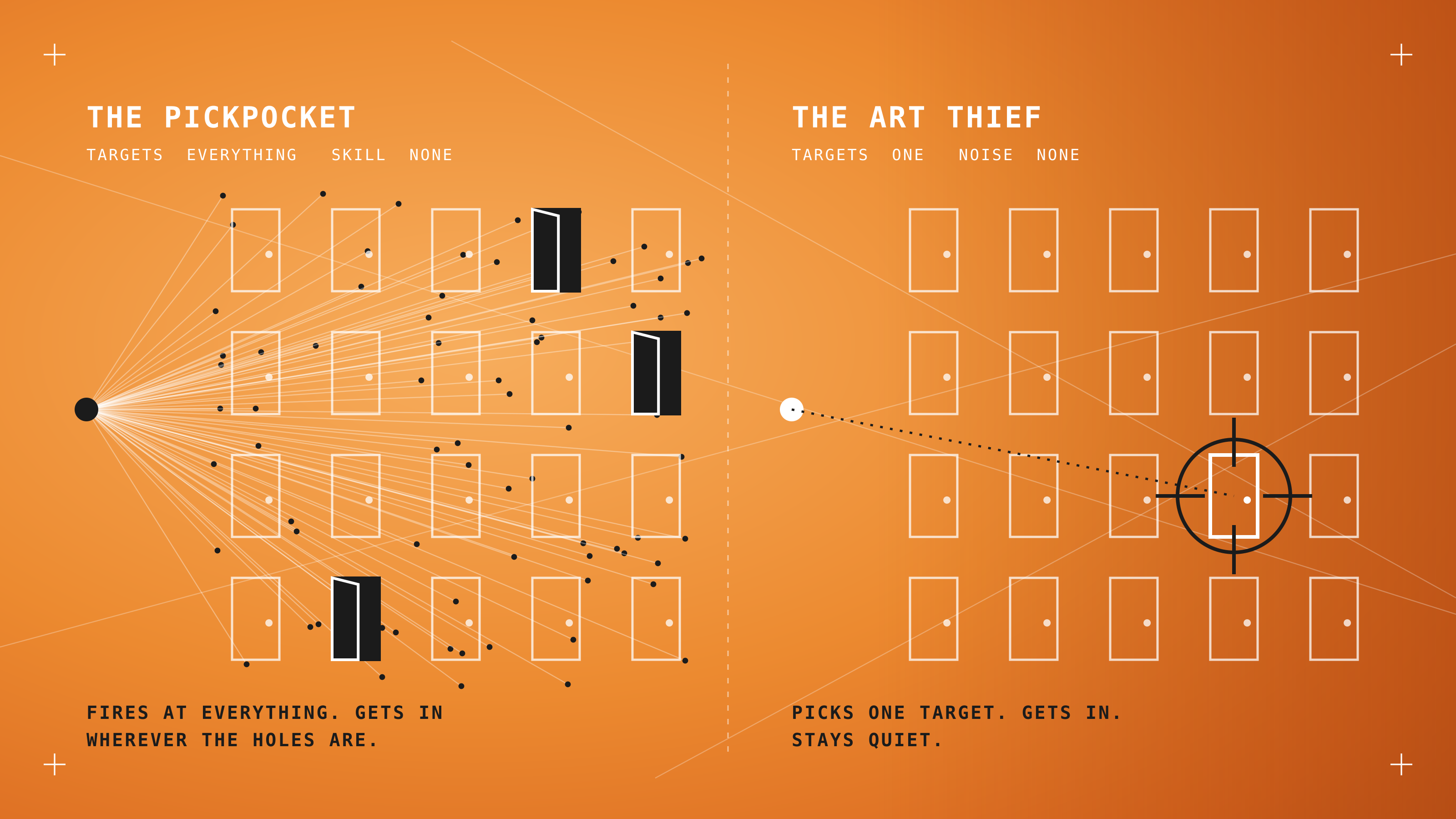
The rest are firing shotgun shells across the internet to see what sticks. There is no real quality in it, and because their AI is not aimed at any professional objective, all they can do is point it at the most obvious and easiest systems. Whoever has the most holes becomes the first victim.
That does not make them harmless, because even an easy break-in can do real damage and bring your operations to a halt. Most of them also have no idea how to hide, and if someone truly wanted to, they could be traced back to their own front door.
It is like any other kind of crime. One person is a pickpocket, while another steals a painting worth hundreds of millions, gets away with it and already has a buyer waiting. Both are thieves, but only one of them is a professional.
Caught in their own fishnet
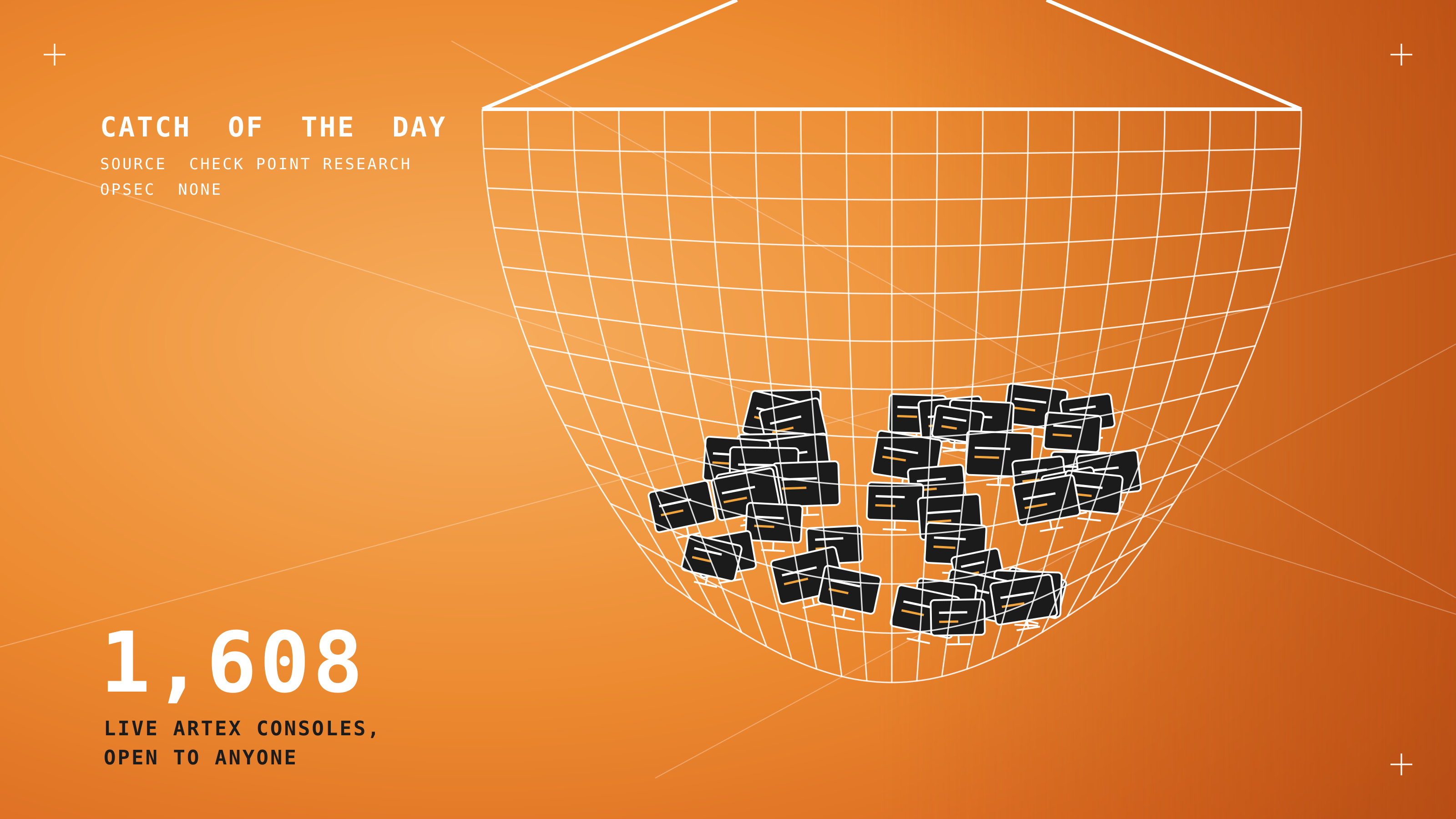
The numbers prove the point. Check Point Research found 2,557 systems that had hosted ARTEX, 1,608 of them live and reachable by anyone on the internet, and ten were set up so badly that their entire databases were exposed, which let the researchers read right over the operators' shoulders.
That is the shotgun crowd showing itself. No advanced persistent threat would be stupid enough to get caught in a big online fishnet that anyone can drag, and the people who left their own control panels open are the same people shooting at yours.
What the researchers saw inside is telling. In one crypto campaign the agents chased 292 objectives, produced 230 findings and burned through 167.5 million tokens, and the attacker made exactly $0. Some agents even reported cash-outs that never happened, simply because an API had answered "success."
So the pickpocket got a robot army, and the robot army lied to him. Do not take comfort in that, though, because along the way one of those agents found exposed cloud storage keys and wrote to the storage that served a crypto service's iPhone app. There was no profit, and it was still a supply-chain compromise.
The biggest ARTEX hit so far tells the same story. CrowdStrike found that the attacker behind the South Korean bank campaign had left his servers wide open, complete with his Claude Code session histories, his ARTEX settings, his AI's memory files and a CLAUDE.md file holding his Chinese-language instructions on how the AI should run the attack.
It gets better. He asked Claude where Korean breach data is usually sold, and he had it write him a security researcher résumé with the ARTEX results as bullet points, leaving his personal details in the logs along the way. He did not even get in through the core banking systems, but through a loan inquiry service for brokers and an employee mobile app.
That is a pickpocket who found an unlocked side door at a bank, and it still exposed the data of about 67,000 people.
What a robot army costs
What does all of this cost the pickpocket? Practically nothing: the cheapest version is the electricity in his mother's basement and the GPU he got for Christmas a few years ago.
That Christmas GPU is enough to run an open model at home, so the brain costs him nothing but power. If he wants more, he buys stolen API keys and lets someone else's account pay the bill. And even paying full price, the brain is cheap: researchers at Vals, quoted by Tech.co, put one attack at $2 to $3 in tokens on DeepSeek. When the guardrails on Anthropic's Claude stopped one operator in Check Point's data, he simply switched to a more permissive Chinese model and carried on.
Most of these people cannot write even basic code, and they do not need to. Some of them also work for someone who can.
We have seen this business model before. With ransomware-as-a-service, one group builds the ransomware and others rent it for a cut of the profits, so the renter only has to get you to click or download something somebody else made. He did not build the weapon, but the damage is just as real.
The art thief's toolbox
Now picture a professional with the same tool. He is not running a cheap model in a basement; he may be using stolen logins and API keys for the best frontier models to get the highest quality, with hundreds of GPUs or tens of thousands of other people's computers doing the calculations for him.
That is the other half of the FBI's advisory: a supply-chain hit through ConnectWise that reached more than 2,250 customer environments, an Active Directory sweep of more than 110,000 objects, forged login tokens, stolen cloud credentials and web shells left behind for later. None of that is a pickpocket's work.
If you are the kind of target an art thief wants, what should worry you is not his budget, but the chance that he tests your systems before you do.
The new mugshot
Look at the mugshots of online criminals from years ago. Leaving aside whether what they did was right, you could tell from the photos that these guys lived on their computers and loved the machine.
Look at the mugshots now, and more often than not you see goofy haircuts, earrings, flashy white teeth and money spent on Lamborghinis and clubs. That is not exactly the type you picture at a Linux terminal, yet the money was made with criminal methods in the digital world.

Put two of them side by side. Joshua Schulte was a software engineer in the CIA's offensive cyber unit who stole the agency's hacking tools and handed them to WikiLeaks as Vault 7, and in 2024 he was sentenced to 40 years. Whatever else you think of him, nobody doubts he knew his way around a terminal.
Malone Lam is the other kind. He is an eighth-grade dropout who in September 2026 pleaded guilty to leading a ring that stole more than $245 million in bitcoin, and the trick that got them in was no exploit at all: his co-conspirators simply posed as Google and Gemini support staff. The money went on more than 30 cars, a $2 million watch and one Los Angeles nightclub bill of $569,000 in a single evening. The average Linux nerd does not live like that.
That should tell you something: the tools now do the part that used to take a real nerd. Earlier this month we wrote that the sweaty lone nerd is dead, and this is who took his chair.
Three hours
Under three hours, from first touch to admin rights. Now ask yourself when your last pentest was, because if the answer is "last year," an attacker has had close to 3,000 three-hour windows since then.
Nobody out-reacts three hours, so the only defence is to be closed already. Get a quality test, one that finds the most vicious holes in your system, and close them before anyone else finds them.
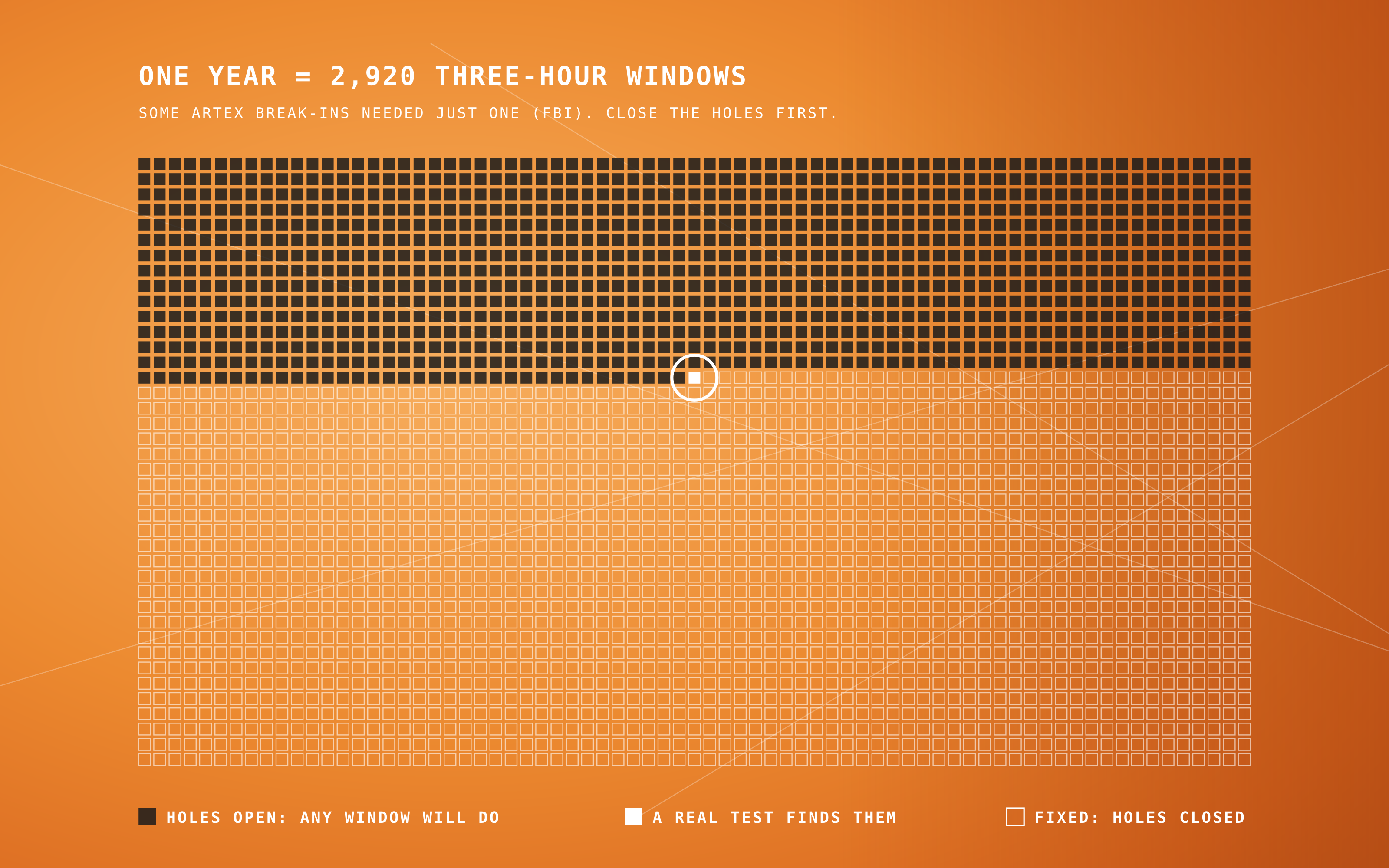
Then the only one left to worry about is the guy with nothing better to do than fire shotgun shells online, and he goes after whoever has the most holes. Make sure that is someone else.
Monday morning
The FBI's list of fixes is long and worth reading in full. It asks you to inventory every internet-facing app, including the forgotten ones, lock down admin and management interfaces, put rate limits on your portals and APIs, and scan your code and pipelines for leaked secrets. If you use ConnectWise, follow its restoration instructions to the letter.
Mine is shorter.
First, scanning is nice, but hacking is better. A scan tells you what might be wrong, so do what they could do to you, and then let a professional hack you even harder.
Second, be a little paranoid. Many of us were taught not to be, but a police officer cannot be naive and believe everyone, and in this day and age neither can you. Not trusting everything at first glance is a healthy trait and a good survival strategy.
The pickpocket now has a robot army. The art thief has had one for a while.
Hack yourself first. Before someone else does.
Sources
- FBI FLASH: Threat Overview of the ARTEX Autonomous Penetration Testing Framework, 13 November 2026
- Inside ARTEX: How Autonomous AI Agents Are Being Used in Real-World Cyberattacks, Check Point Research
- Unknown Threat Actor Uses AI-Driven ARTEX to Target South Korean Finance, CrowdStrike
- Hacker used ARTEX AI and Claude agents to target South Korean banks, BleepingComputer, 10 October 2026
- Study: Cyber Criminals Are Letting AI Do the Hacking, Tech.co
- Disrupting the first reported AI-orchestrated cyber espionage campaign, Anthropic, 13 November 2025
- 1980s tech gadgets that are now obsolete, History.com
- Wikileaks source and former CIA worker Joshua Schulte sentenced to 40 years jail, The Register, 2 February 2024
- 8th grade dropout pleads guilty to orchestrating $240 million bitcoin theft from DC resident, Associated Press, 11 September 2026
- Singaporean Ringleader of $245 Million Cryptocurrency Racketeering Enterprise Pleads Guilty, U.S. Department of Justice, 8 September 2026
- The sweaty lone nerd is dead, Nergal
- Think like the other side, Nergal